Translate

Showing posts with label wind power. Show all posts

Monday, March 14, 2022

La Gomera to generate 70% of its energy from wind

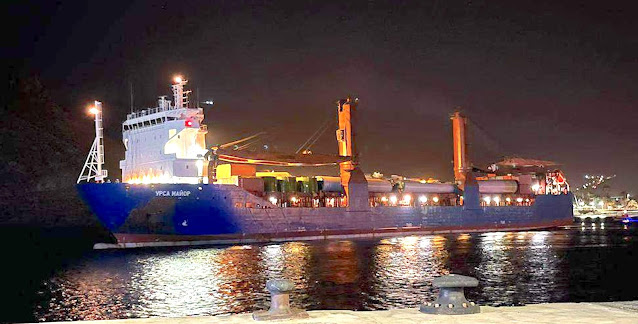
Ship arriving with parts for wind turbines in San Sebastian de La Gomera's port
Parts for the new wind turbines arriving in the port of San Sebastian de La Gomera last month (Image: gomeranoticias.com)

Finally the planned construction of wind tubines in La Gomera is going ahead and the arrival last month of the first large parts for the wind turbines heralds the end for the ageing and very smelly diesel generator driven power station in the island's capital San Sebastian de La Gomera.
The new large windmills will be constructed in three wind parks in the mountains above the capital, one of them near 'El Camello'. This desolate spot once had indeed camel stables, then it housed a discotheque and nightclub, and after that had closed down refugees from Africa were housed there in container homes.
The three wind parks, once completed, will generate up to seven megawatts of electricity and should cover 70% of the island's 10MW average demand.
The plan to generate all of La Gomera's electricity from renewable sources was drawn up in 2019 and the arrival of the first segments of the windmills was hailed as a historic moment by the authorities.
The aim is to become 100% self sufficient in electricity generation and the next step in the island government's plan is the construction of solar photovoltaic parks to augment wind energy and to provide stability of the grid. Some of the diesel generators will probably remain on stand-by.
The new windmills will hopefully be a lot more reliable and sturdy than the only two previous turbines near Epina that never worked very well. One of them even got blown down in a storm a few years ago (more here...).

Thursday, February 01, 2018

Wind turbine blown down

The blown down wind turbine near Epina (Images: gomeranoticias.com)
The recent gales and storm force winds have blown down one of La Gomera's two wind tubines situated on a high ridge near the village of Epina in the island's west. The two windmills there were erected in 1996 and ironically the one destroyed had only recently been refurbished, while the other which survived the gales was turned off at the time of the incident awaiting refurbishment. The two wind turbines generated over 500 kw/h of electricity last year. The strong winds gusted over 100 km/h in La Gomera's mountains several times in recent days and for the next few days it will stay very windy and gusty in exposed areas. Warnings of strong winds gusting 75 km/h have been issued for Friday Feb.2nd 2018, and for Saturday. For Saturday there's an additional warning of rough seas. However, even today it is very windy here again and the weather station on La Gomera's highest peak recorded a wind gust of 93 km/h at 9:40 am.

Monday, November 09, 2015

Island of El Hierro exemplary in renewable energy

Our smaller neighbouring island to the south, El Hierro, has become self-sufficient in electrical energy. The Spanish daily El Pais reports:
An aerial view of the Gorona del Viento wind-hydro plant. / DESIREE MARTIN (AFP)
In the coming decades the system will save El Hierro around €80 million that would have been spent on 6,000 tons of diesel each year
El Hierro, the smallest and most westerly of the Canary Islands, has become the first isolated territory in the world to meet all its energy needs using renewables. For four hours from 12 noon on Sunday August 9, the Gorona del Viento wind-hydro power station generated all the electricity for the tiny island of 10,000 inhabitants using clean energy – the culmination of a project that began 30 years ago.
“It’s amazing!” says Gonzalo Piernavieja, head of research, development and innovation at the Canaries Technological Institute, one of the entities taking part in the local council-led project, along with power company Endesa and the Canary Islands regional government.
The Gorona del Viento wind-hydro power station has been hooked up to five wind-powered generators that together are able to produce the 35 GW/h the island requires. In the coming decades the system will save El Hierro around €80 million that would have been spent on 6,000 tons of diesel each year, as well as reducing carbon emissions by around 20,000 tons annually.
The project, which has cost €82 million, has been hailed as a major achievement around the world. It represents the first time that wind and hydro power have been combined. Once the wind farm has generated enough energy to meet the island’s needs, the excess is fed into the power station’s pumps, which raise water from a reservoir located at sea level to a height of 700 meters. On days when the wind is not sufficient to provide the required energy, the hydraulic installation comes into play. The water is channeled back down to the lower reservoir, moving the turbines that produce the electricity needed for the island.
Around 80 percent of El Hierro’s energy is already produced via renewables, but that figure can rise to 100 percent for certain periods, sometimes of up to a week, says Piernavieja. “There are Pacific islands with fewer than 1,000 inhabitants, as well as some African communities, that have also been able to meet all their energy needs using renewables, but nothing compares to what we have achieved on El Hierro, both in terms of the number of people we are supplying, as well as the fact that our system is not connected to the outside world, and is housed entirely on the island.”
BelĂ©n Allende, the head of the local council on El Hierro, says she is proud of the achievement: “This is a day that will be remembered by the rest of the world.” She hopes that El Hierro’s know-how will be used by other islands. “There are around 17 million people living on islands in Europe, and 600 million across the planet,” she says, adding that the plan now is for El Hierro to become a kind of open-air laboratory for other environmental initiatives. Representatives from Japan, Taiwan and the Faroe Islands have recently visited El Hierro to look at how to adapt the technology to their own needs.

Monday, November 24, 2014

Wind turbine blown down

Hermigua turbine
OPC chart for Thursday

The strong winds of yesterday which gusted to nearly 100 km/h in the mountains of La Gomera blew down the relatively new wind turbine which feeds into the charging station for electric cars in the northern town of Hermigua. 
Today the weather is much better and it will remain mostly sunny for the next few days. However, unsettled weather is forecast to return to the Canary Islands in the second half of the week when a new low pressure system is expected to form north of the islands which could bring more wind and rain. 

Tuesday, June 17, 2014

Petrol or Diesel ? No thank you !

Plenty of energy for free in the Canary Islands
There are several public charging points for electric cars all over La Gomera. The fairly new one below is about a mile west of Hermigua on the main road to Agulo. Here you can charge your car with a mix of solar and wind power. All we need now is affordable electric cars.
Wind and sun power this electric car charging-point